Executive Summary
This report investigates the financial impact of modernising homes in the UK, specifically focusing on the return on investment (ROI) from installing composite fencing, composite decking, and modern render. Initial research suggests that such improvements can increase home values by 5-10%. This study validates these claims by analysing regional property price data from the UK House Price Index (UK HPI) and applying estimated modernisation costs, adjusted for regional variations.
In the context of the current cooling UK housing market, with prices rising by just 1.3% annually and buyer inquiries declining, strategic home modernisation emerges as a potential countermeasure for homeowners. The research reveals that while the broader market stalls, modernised homes can still achieve 5-10% value premiums, effectively outperforming the market average. This creates what we term a “modernisation premium” – the ability for updated properties to maintain value resilience even during market slowdowns.
A key outcome of this analysis is a regional map of the UK illustrating the potential ROI, which demonstrates significant variations across regions that mirror the current divergent market trends, with Northern Ireland showing strong growth (6.5%) while southern England cools significantly.
Introduction
Home modernisation projects are often undertaken to enhance living comfort, aesthetic appeal, and energy efficiency. Beyond these immediate benefits, a significant motivation for homeowners is the potential to increase property value. This report focuses on three popular modernisation techniques: composite fencing, composite decking, and modern render. These choices are driven by their increasing popularity and perceived value addition.
The objective is to provide a data-driven analysis of their return on investment across different regions of the UK, particularly in the context of the current housing market, which Halifax describes as “stuck in the mud” rather than “running off a cliff” [1]. With buyer inquiries dropping to a net balance of -17 in August (RICS data) and agreed sales slipping to -24, sellers are facing increasingly challenging conditions [2]. Properties are more likely to sell below asking price, and competition for the shrinking pool of active buyers is intensifying.
In this environment, understanding the potential ROI of modernisation becomes even more critical for homeowners looking to protect and enhance their property’s value.
Current UK Housing Market Context
2.1 Market Slowdown
The UK housing market is showing clear signs of deceleration. According to Halifax, annual price growth slowed to just 1.3% in September 2025—the weakest since April 2024 [1]. Monthly prices have actually fallen by 0.3% (£794), bringing the average home price to £298,184. This confounded economists’ expectations, who had forecast growth to pick up to 2.2%.
“While affordability remains a challenge, a relatively lower mortgage rate environment and steady wage growth have helped support buyer confidence. Although the broader economic outlook remains uncertain, with the affordability picture gradually improving, we continue to expect modest growth through the remainder of the year.” — Amanda Bryden, Head of Mortgages at Halifax [1]
The Bank of England has maintained interest rates at 4% after five rate cuts since last summer. However, persistent inflation, at 3.8% in August (nearly double the central bank’s target), is creating additional economic uncertainty [1].
2.2 Buyer Behavior
The Royal Institution of Chartered Surveyors (RICS) survey reveals that new buyer inquiries dropped to a net balance of -17 in August, down from -7 in July, representing the lowest figure since May [2]. Agreed sales have also declined to -24 in August from -17 the month before.
There is evidence that buyers are holding back before Rachel Reeves’s budget on November 26, with speculation about potential tax changes creating market hesitancy. The Guardian reported in August that the chancellor was considering replacing stamp duty with a new levy on the sale of homes worth more than £500,000 [1].
“With buyer demand easing and agreed sales in decline, the housing market is clearly feeling the effects of ongoing uncertainty. Concerns over the wider economic and fiscal outlook, combined with questions around the future path of interest rates amid stubbornly high inflation, are weighing on sentiment at this time.” — Tarrant Parsons, RICS Head of Market Research and Analysis [2]
This uncertainty is particularly affecting higher-value properties, with demand for homes priced over £1 million falling by 11%, and by 4% for properties over £500,000 [3].
2.3 Regional Variations
The UK property market is experiencing dramatic regional variations. Northern Ireland continues to post the biggest annual house price growth of any region, seeing 6.5% growth in the year to September, with the average home now worth £216,496 [1].
Scotland and the North East of England were also among the regions that saw the most robust increases over the year to September. In Scotland, the average home value grew by 4.5% to £215,588, while in the North East, prices were up 4.8% to £180,443 [1].
In contrast, price growth in the south of England, where property prices tend to be highest, continues to cool. The average house price in the South West has fallen by 0.2% in the year to September, with a typical home now worth £303,067. In Greater London, prices are up by just 0.6% annually to £543,497 [1].
These regional disparities create a complex landscape for homeowners considering modernisation investments, with potential returns varying significantly based on location.
Methodology
3.1 Data Collection
Property Value Data: Regional average house prices were obtained from the UK House Price Index (UK HPI) for May 2025 [4]. This dataset provides comprehensive property transaction data across various administrative geographies in the UK.
Modernisation Cost Data: National average costs for composite fencing, composite decking, and modern render were estimated based on industry averages and publicly available information. These costs include both materials and labor.
- Composite Fencing: Estimated national average cost of £1,580 for a typical installation.
- Composite Decking: Estimated national average cost of £2,000 for a medium-sized deck (approx. 20 m²).
- Modern Render: Estimated national average cost of £4,950 for a typical three-bedroom semi-detached home.
Regional Cost Multipliers: To account for regional variations in construction and labor costs, multipliers were applied based on data from Costmodelling.com [5]. The UK average was set at 100, with specific regional adjustments:
- North East: 0.92
- South East: 1.07
- Northern Ireland: 0.81
- Other regions were assumed to be at the national average (1.00) due to lack of specific data.
3.2 ROI Calculation
The total estimated cost for a combined home modernisation project (fencing, decking, and rendering) was calculated for each region by applying the respective cost multipliers. This total national average cost was approximately £8,530.
Two scenarios for property value increase were considered, based on the initial research suggestion of 5-10%:
- Scenario 1: A 5% increase in the regional average property price.
- Scenario 2: A 10% increase in the regional average property price.
The Return on Investment (ROI) for each scenario was calculated using the formula:
$$ ROI = \frac{(Value Increase – Modernisation Cost)}{Modernisation Cost} \times 100 $$
3.3 Market Context Integration
To understand how modernisation ROI might be affected by current market conditions, we integrated the latest housing market data from Halifax and RICS [1][2]. This allowed us to analyse how the “modernisation premium” might perform against the backdrop of a cooling market with regional variations.
Findings and Analysis
The analysis reveals significant regional disparities in the potential ROI of home modernisation projects. While a 5-10% increase in property value is a general guideline, the actual financial benefit is heavily influenced by the local property market and regional construction costs.
4.1 Regional ROI Overview
The following table presents a selection of regions and their calculated ROI for both 5% and 10% property value increases. The full dataset is available in the accompanying google sheet file.
| Region Name | Average Property Price (£) | Regional Modernisation Cost (£) | Value Increase (5%) (£) | ROI (5%) (%) | Value Increase (10%) (£) | ROI (10%) (%) | Current Annual Growth Rate (%) |
| Aberdeenshire | 200,569 | 8,530 | 10,028 | 17.57 | 20,057 | 135.13 | 3.2* |
| Adur | 366,869 | 8,530 | 18,343 | 115.05 | 36,687 | 330.09 | 0.3* |
| Barnet | 590,194 | 8,530 | 29,510 | 245.95 | 59,019 | 591.90 | 0.6 |
| Blackpool | 128,930 | 8,530 | 6,447 | -24.43 | 12,893 | 51.15 | 2.1* |
| City of London | 823,848 | 8,530 | 41,192 | 382.91 | 82,385 | 865.82 | 0.6 |
| County Durham | 136,156 | 8,530 | 6,808 | -20.19 | 13,616 | 59.62 | 4.8 |
| Inner London | 659,263 | 8,530 | 32,963 | 286.44 | 65,926 | 672.88 | 0.6 |
| Kensington and Chelsea | 1,415,478 | 8,530 | 70,774 | 729.71 | 141,548 | 1559.41 | 0.6 |
| North East | 169,244 | 7,848 | 8,462 | 7.82 | 16,924 | 115.67 | 4.8 |
| South East | 339,747 | 9,127 | 16,987 | 86.12 | 33,975 | 272.27 | 0.3* |
| Northern Ireland | 216,496 | 6,909 | 10,825 | 56.67 | 21,650 | 213.35 | 6.5 |
| Scotland | 215,588 | 8,530 | 10,779 | 26.37 | 21,559 | 152.74 | 4.5 |
| South West | 303,067 | 8,530 | 15,153 | 77.65 | 30,307 | 255.30 | -0.2 |
Note: Regional Modernisation Cost is adjusted by regional multipliers where available. For regions not explicitly listed in the multiplier data, the ‘United Kingdom’ multiplier of 1.00 was used. Current Annual Growth Rate is based on Halifax data from September 2025 [1]. Asterisked () growth rates are estimated based on regional trends where specific data was not available.*
4.2 Key Observations
4.2.1 The Modernisation Premium in High-Value Areas
Regions with higher average property prices, such as London boroughs (e.g., Kensington and Chelsea, City of London, Barnet) and parts of the South East, consistently show significantly higher ROI percentages. This is because a 5% or 10% increase on a higher base value translates into a much larger absolute value increase, often dwarfing the modernisation costs.
What’s particularly notable is that these high-value areas are currently experiencing some of the slowest market growth. London prices are up by just 0.6% annually [1], yet the potential ROI from modernisation remains exceptionally high. This creates what we term a “modernisation premium” – the ability for updated properties to significantly outperform the local market average.
For example, in Kensington and Chelsea, where the average property price is £1,415,478, a 5% value increase from modernisation would yield a 729.71% ROI, despite the broader London market growing at just 0.6% annually. This suggests that modernisation could be a powerful strategy for homeowners in high-value areas looking to protect and enhance their property’s value in a cooling market.
4.2.2 Budget Uncertainty Impact on High-Value Properties
With the November 26th budget looming and speculation about potential tax changes affecting properties worth over £500,000, the market for higher-value homes is experiencing particular uncertainty. Demand for homes priced over £1 million has fallen by 11%, and by 4% for properties over £500,000 [3].
In this context, modernisation could provide a strategic advantage for sellers of high-value properties. By creating a more appealing, move-in ready home with contemporary features, sellers can differentiate their property in a market where buyers have become more selective and cautious.
4.2.3 Regional Growth Variations and Modernisation Strategy
The dramatic regional variations in current market performance suggest that modernisation strategies should be tailored to local conditions:
Strong Growth Regions (Northern Ireland, Scotland, North East): In these areas, where annual price growth ranges from 4.5% to 6.5% [1], modernisation can amplify already positive market momentum. The combination of natural market appreciation and the modernisation premium can create particularly favorable conditions for homeowners.
Stagnant or Declining Regions (South West, parts of London): In areas experiencing minimal growth or even decline, such as the South West (-0.2% annually) [1], modernisation becomes more of a defensive strategy. While the broader market stagnates, modernised properties can still achieve value increases, helping homeowners maintain equity and improve saleability in challenging conditions.
4.2.4 Negative ROI Risk in Lower-Value Areas
In some regions with lower average property prices (e.g., Blackpool, County Durham), a 5% value increase may not be sufficient to cover the modernisation costs, resulting in a negative ROI. Even a 10% increase might yield a modest ROI in these areas.
This risk is particularly relevant in the current market environment, where buyer caution could make achieving the full 5-10% value increase more challenging. Homeowners in lower-value areas should carefully consider the quality and extent of modernisation work to ensure it can deliver at least a 10% value increase to achieve positive returns.
4.3 The Buyer’s Market Context
With buyer inquiries dropping to -17 and agreed sales at -24 [2], the UK is increasingly becoming a buyer’s market, where properties are more likely to sell below asking price and sellers must compete more aggressively for the shrinking pool of active buyers.
In this environment, modernisation creates crucial differentiation. When buyers have more options and negotiating power, they’re gravitating toward move-in ready properties with contemporary features that offer both aesthetic appeal and lower maintenance requirements.
The ROI data suggests that even in regions experiencing price declines, such as the South West (-0.2% annually), modernised homes can still achieve positive returns if they can secure a 5-10% premium over non-modernised equivalents. This indicates that the “modernisation premium” may be particularly valuable during market slowdowns, when standard properties struggle to maintain value.
UK Regional ROI Map
An interactive choropleth map has been generated to visually represent the regional ROI across the UK. The map allows users to toggle between the 5% and 10% value increase scenarios, providing a clear geographical overview of where modernisation projects are likely to yield the highest returns. The map is saved as uk_roi_map.html.
The map reveals a clear pattern that aligns with current market trends: areas with the highest potential ROI often correspond to regions where the market is currently cooling (such as London and the South East), while areas with more modest ROI potential include some regions that are currently showing stronger market growth (such as the North East).
This counterintuitive pattern suggests that modernisation may be most financially beneficial precisely in those areas where the broader market is underperforming, as it creates a more significant competitive advantage relative to non-modernised properties.
Strategic Implications for Homeowners
6.1 Timing Considerations
With the November 26th budget approaching and widespread speculation about property tax reforms, homeowners face additional uncertainty. Market data shows demand for homes priced over £500,000 has fallen by 4%, and for those over £1 million by 11%, as buyers adopt a “wait and see” approach [3].
For homeowners considering selling in the near future, modernisation represents a proactive strategy to counter this market hesitancy. By investing in improvements that enhance value now, homeowners can potentially offset future tax impacts while simultaneously improving their property’s appeal to the reduced pool of active buyers.
6.2 Regional Strategy Recommendations
Based on the combined analysis of current market trends and modernisation ROI potential, we can offer the following strategic recommendations for homeowners:
High-Value Areas with Slow Growth (London, South East):
- Prioritise high-quality modernisation to maximise the “modernisation premium”
- Focus on contemporary aesthetics and low-maintenance features that appeal to selective buyers
- Consider accelerating planned improvements ahead of potential tax changes in the November budget
Strong Growth Regions (Northern Ireland, Scotland, North East):
- Modernisation can amplify already positive market momentum
- Even modest improvements may yield good returns due to the favorable market conditions
- Consider the full package of fencing, decking, and render to maximise value enhancement
Stagnant or Declining Regions (South West):
- Be selective about modernisation investments, focusing on high-impact, visible improvements
- Ensure quality execution to achieve the higher end of the 5-10% value increase range
- Consider phasing improvements if budget constraints are a concern
Lower-Value Areas (Blackpool, County Durham):
- Focus only on high-quality modernisation that can achieve a 10%+ value increase
- Consider more limited improvements focused on curb appeal rather than the full package
- Evaluate whether modernisation for personal enjoyment rather than ROI might be more appropriate
Conclusion
The research confirms that modernising a home with composite fencing, composite decking, and modern render can indeed increase its asking price, aligning with the initial suggestion of a 5-10% value increase. However, the Return on Investment is highly dependent on the regional property market value. Homeowners in high-value areas are likely to see substantial returns, while those in lower-value areas may experience more modest or even negative returns, especially if the value increase is at the lower end of the 5-10% spectrum.
In the context of the current cooling UK housing market, with prices rising by just 1.3% annually and buyer inquiries declining, strategic home modernisation emerges as a potential countermeasure for homeowners. The “modernisation premium” – the ability for updated properties to outperform local market averages – becomes particularly valuable during market slowdowns, when standard properties struggle to maintain value.
As Sarah Coles of Hargreaves Lansdown notes, the current market is “not running off a cliff, it’s one that’s stuck in the mud” [1]. In such an environment, modernisation can provide the differentiation needed to stand out in a buyer’s market, where properties are more likely to sell below asking price and sellers must compete more aggressively for the shrinking pool of active buyers.
This analysis provides valuable insights for homeowners, property developers, and real estate professionals considering modernisation projects in the current market context. It underscores the importance of conducting regional market research before investing in home improvements and considering how the “modernisation premium” might perform against the backdrop of local market conditions.
References
[1] The Guardian. (2025, October 7). UK house price growth slows as buyers show caution before budget
[2] Reuters. (2025, September 10). UK housing market slows as buyers retreat, uncertainty swirls, RICS survey shows
[3] Forbes. (2025, October 7). Property Price Growth Slows In Wake Of Budget Fears
[4] UK House Price Index. (2025, May). HM Land Registry. Available at: https://landregistry.data.gov.uk/app/ukhpi/
[5] UK Construction Cost Regional Variations. (2025, July 1). Costmodelling.com. Available at: https://costmodelling.com/regional-variations
If you’re thinking about installing a new fence or upgrading your existing one, you’ve likely compared various fencing materials. Traditional wood fencing has that classic charm, but it’s prone to rot, warping, and constant upkeep. Metal fencing may offer durability but can feel cold and industrial, especially in a garden setting.
That’s where composite fencing stands out. It’s one of the best modern fencing solutions available for homeowners who want long-lasting style with minimal effort.
What Is Composite Fencing Made Of?
Before looking at the advantages of composite fencing, let’s clarify what it actually is.
Composite fencing is made from a blend of recycled wood fibres and plastic, creating a highly durable and weather-resistant composite material. This mix delivers the best of both wood and plastic: the natural appearance of a wooden fence with the strength and low-maintenance benefits of synthetic components.
Since it’s manufactured—unlike natural wood fencing—it resists rot, warping, and decay. That means you get the look of real wood without the typical downsides of traditional timber fencing.
What Are the Benefits of Modern Composite Fencing?
So, what are the benefits of composite fencing? Let’s explore why more homeowners are choosing it as their preferred fencing option.
1. Minimal Maintenance, Maximum Convenience
Traditional wooden fence panels demand regular care—painting, treating, or replacing damaged boards. But composite fences eliminate all that work.
- Composite fence panels don’t warp or splinter
- No need for sealants or stains
- Easily cleaned with water and soap
In short, installing composite fencing means fewer chores and more time enjoying your outdoor space.
2. Built to Withstand Harsh Weather
One of the biggest composite fencing benefits is its superior durability. Unlike traditional fencing materials, composite holds strong against:
- Strong winds
- UV exposure
- Heavy rain or snow
It doesn’t crack or weaken over time like natural wood fencing. Thanks to its engineered strength, many composite fencing products come with warranties ranging from 15 to 25 years—and some, like eComposite’s ForeverFence™, come with a lifetime warranty.
3. Eco-Friendly and Sustainable
Composite fencing is made from recycled materials—typically 90% of its content includes recycled plastic and wood fibres.
By choosing composite fencing, you’re:
- Reducing demand for freshly cut timber
- Diverting plastic from landfills
- Investing in a sustainable fencing solution
For eco-conscious homeowners, it’s a clear win over traditional wood fences.
4. Easy Installation With Existing Posts
Worried about tearing out your old fence? Don’t be. Composite panels can be easily retrofitted into existing concrete fence posts, saving you time, cost, and effort.
- Panels are lightweight and simple to handle
- No specialist tools required
- Perfect for DIY or professional installation
Installing composite fencing offers a smoother, faster alternative to building a traditional timber fence from scratch.
5. Aesthetic Variety to Match Any Space
Composite fencing comes in a range of colours and styles, many of which mimic natural wood grain. Whether you prefer slate grey, chestnut brown, or pebble woodgrain, there’s an option to suit any aesthetic.
Unlike wood fencing, which fades and grays over time, composite fence boards retain their colour year after year—with zero restaining required.
You can also pair it with matching composite fence posts and decking for a unified look across your garden.
Why Choose eComposite Products?
At eComposite, we specialise in high-quality composite fencing systems designed for performance, style, and longevity.
Our Signature Benefits:
- ForeverFence™ Lifetime Warranty
- Wind resistance up to 150 mph
- Made from 90% recycled materials
- 4.8-star rating from over 700 customers on Trustpilot
Unlike traditional wood fencing, our products are engineered to last, withstand the elements, and stay looking great for decades. When you choose composite fencing from eComposite, you’re investing in peace of mind and a smarter, more sustainable future.
Contact Us Today
Ready to enjoy the full advantages of composite fencing? Whether you’re planning a new installation or replacing your old wooden fence, we’re here to help.
Call us at 01543 471348 or visit our showroom to explore our range of composite fencing materials in person. Or simply get a free quote online today.
Having outdoor space at your property is a huge asset. Being able to step outside and into your garden offers so many benefits. From simply sitting in the fresh air and watching the wildlife with a cup of tea in your back garden, through to entertaining loved ones in your outdoor space, gardens can certainly enrich our lives in many ways. However, to enjoy the full potential of your garden, it needs to be a secure, private, and attractive space. This is something that can be achieved with help from the right garden fence.
Your fence in your garden can have a significant impact on the appearance of your garden and the way you design it. Choosing the best material for fencing is essential, and this doesn’t mean you need to stick with the same old timber fence panels that need repainting or replacing every few years. Instead, composite fencing is an increasingly popular choice selected by both homeowners and businesses. You can explore our full range of composite fencing products to find the perfect fit for your outdoor space.
In this blog, we’ll explain exactly what composite fencing is, what composite fencing is made of, and everything you need to know about this modern composite fencing solution. We’ll also detail the key features of composite fencing to help you learn more about this exciting option compared to other fencing types.
What is Composite Fencing?
Choosing the right fence for your garden is an important decision. So, it’s essential you consider your fencing options and choose the best fencing for your needs. Commonly, fences in the UK used on residential properties are made from wooden fence panels, and commercial buildings usually opt for metal or aluminium fence systems. However, there is a third choice beyond these often-used fencing materials, and that is composite fencing.
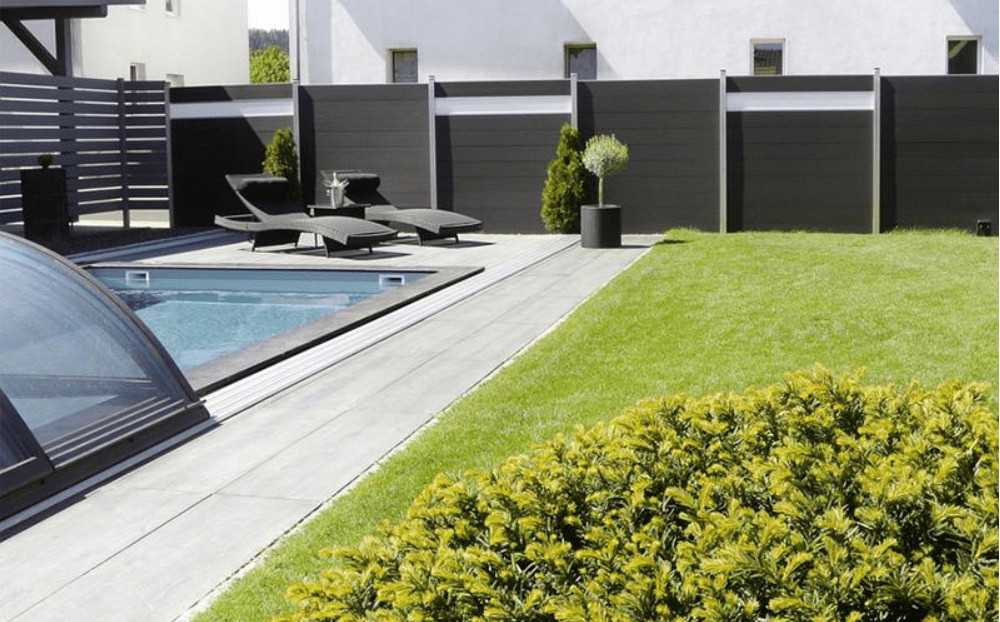
So, what is composite fencing? Composite fencing is a fencing system that is manufactured from a combination of recycled materials—including recycled plastic, recycled wood fibres, and an eco-friendly bonding agent. This mix of composite materials results in a strong, weather-resistant alternative to traditional timber fencing. It can be retrofitted and used with existing concrete fence posts, making it a versatile and convenient fencing solution.
Why Choose Composite Fencing?
Composite fencing offers an impressive array of features which make it an increasingly popular fencing material when compared to traditional timber fencing. Here are just some of the pros of composite fencing which make it such an attractive option:
Aesthetic Appeal
A fence may be a functional feature in your garden—used to create a boundary, provide privacy, and increase your security. However, it is also a design element that contributes to your outdoor space’s style. Choosing the correct fencing material and considering its aesthetic appeal is vital.
As fencing is such a prominent feature throughout the garden, it strongly influences the appearance of the space. If your fencing looks attractive, it helps set the tone for the entire garden.
Composite fence panels are an ideal choice if you want fencing that stays looking good without constant upkeep. eComposite composite fencing products come in a wide range of composite fencing options, so you can match it to the aesthetic of your space. Choose from seven fence panel colours, a variety of composite fence posts, and decorative extras like trellis or LED lighting to enhance your decorative fence design.
Strong and Long-Lasting
We’ve all experienced the hassle of timber fence panels breaking, warping, or rotting. Strong winds, accidental damage, and general wear can degrade traditional wooden fencing quickly. One of the key benefits of composite fencing is its long lifespan and exceptional strength.
At eComposite, when you purchase and register your fence, you receive a lifetime warranty. Unlike wood fencing, our composite fence boards won’t rot, splinter, or decay—even after decades of exposure to harsh weather. Composite fencing is also low-maintenance, requiring minimal upkeep.
So, what is the lifespan of composite fencing? With proper care (mainly just occasional cleaning), composite fencing can last 25–30 years or more.
Sustainable and Eco-Friendly
Here at eComposite, we believe protecting the planet is a priority. That’s why our composite fencing materials are engineered with sustainability in mind.
Each composite panel is made of 90% recycled materials: 60% recycled plastic, 30% recycled wood, and 10% eco-friendly bonding agents. This makes composite fencing an eco-friendly and sustainable alternative to traditional wood fencing.
Because composite fencing is made from composite materials, there’s no need to chop down trees or contribute to landfill waste. Choosing eco fence options like ours also reduces your need to treat wood with chemical stains or paint. It’s part of why composite fencing is better than many traditional wood options.
Easy to Maintain
Keeping your fence clean and in good shape shouldn’t be a burden. Traditional timber fencing often requires expensive treatments and paint. But composite fencing is easy to install, and even easier to maintain.
Our composite fence panels have lower moisture absorption than wood, meaning they resist rot and mould naturally. Forget repainting or staining every year. All you need to do is clean your composite fence occasionally—no fuss, no expensive products.
Choosing a composite fencing system helps you save time and money while improving the durability and appearance of your outdoor space.
Conclusion: Why Use Composite Fencing?
Composite fencing today is the smart, modern alternative to old timber fencing. If you’re asking what is the best composite fencing or want to compare the pros and cons of composite fencing, eComposite offers some of the best composite fencing products on the market—durable, sustainable, and stylish.
Whether you’re replacing traditional wood fencing, fitting panels to existing concrete posts, or looking for a fully composite solution, our composite fence boards and composite posts are made to last. Designed to fit any outdoor space and suit various fencing ranges, they are also easy to install composite fencing solutions.
So, if you’re ready to choose composite fencing that’s built to last, eComposite has the system, support, and style to make it happen.
When it comes to choosing new gates for your home, the variety of materials available can be overwhelming. Composite gates have emerged as a popular choice, and for good reason. If you’re also considering upgrading your fencing, explore our full range of composite fencing to create a cohesive look across your outdoor space.
Understanding Composite Gates
What are composite gates made of? They are crafted from a clever blend of composite materials, including wood fibres, recycled plastic, and eco-friendly binding agents, all reinforced with a sturdy aluminium frame. This unique combination allows them to replicate the look and feel of real wood while avoiding the common issues that come with traditional timber or metal gates like warping, rust, or cracking.
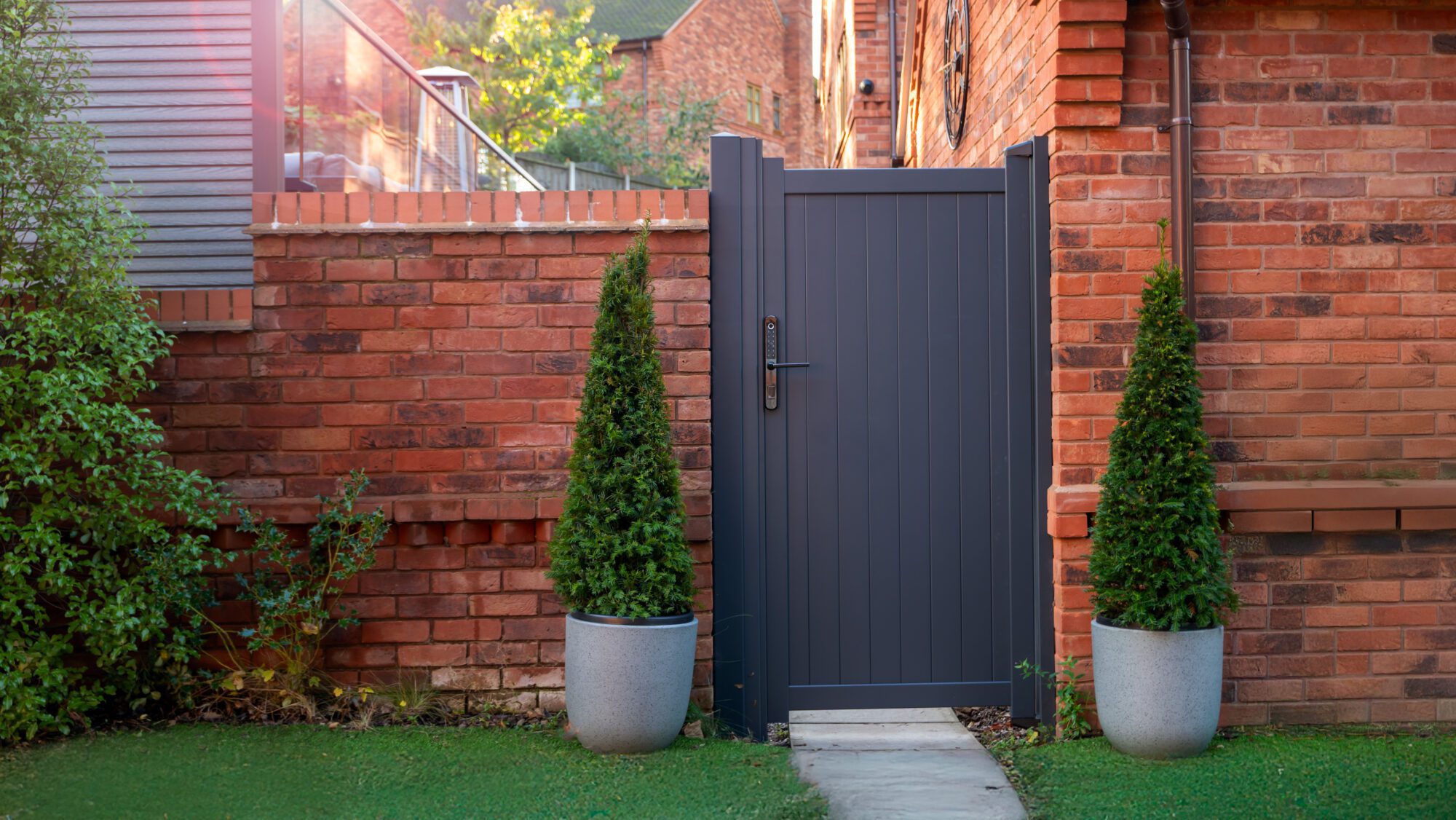
These composite panels are designed for durability, offering the timeless appeal of wood with the strength of metal and the low-maintenance benefits of synthetic materials.
Why Choose Composite Gates?
Composite gates offer a brilliant combination of security, privacy, and style for your home. Unlike some traditional materials, such as iron or aluminium gates, which can appear too industrial, composite gates provide a stylish and seamless first impression while delivering high performance.
Key Benefits of Composite Gates
1. Stunning Kerb Appeal
Composite gates offer a decorative entrance that enhances your property’s look. With a range of composite colours and styles, you can choose a gate that perfectly complements your home. Whether you need a side gate, composite garden gate, or composite driveway gates, there’s a design to suit every space.
2. Hassle-Free Maintenance
One of the major benefits of composite gates is their minimal maintenance. No need to paint, stain, or worry about rot, rust, or termites. A quick clean from time to time is all that’s needed—saving you time and money.
3. Enhanced Privacy
Need more privacy? Composite gates have solid panels that prevent visibility into your property, unlike metal gates or slatted timber styles. They’re a great choice for increased security and seclusion.
4. Built to Last
Composite gates are built to last, offering exceptional longevity. Resistant to strong winds, UV rays, and moisture, these durable composite structures won’t warp or fade over time.
Making the Right Choice
When selecting your gate, consider the following:
- The style of your property
- Your preferred level of privacy and security
- Whether you need a pedestrian gate, garden gate, or driveway gate
- Automation options or compatibility with smart access systems
- Budget, long-term value, and lead times
- Whether you want a made-to-measure or pre-assembled option
Expert Advice at Your Fingertips
At eComposite Products, we’re committed to helping you choose the right fencing and gates. Whether you’re comparing types of composite gates, checking specifications, or wondering how much composite gates cost, our team is ready to help.
We’ll walk you through your range of composite options, from hinges and slats to powder-coated finishes and installation tips.
[Embed contact information or “Get Expert Advice” button here]
Conclusion: The Smart Choice for Modern Homes
What are composite gates? They’re the modern solution for homeowners seeking style, strength, and sustainability in one smart package. With a wide selection of colour options, flexible designs, and impressive weatherproofing, they offer long-term value while elevating your home’s curb appeal.
Ready to transform your entrance? Explore our full range of composite gates and find the perfect match for your home.